Sight as a Service Standard: A 2026 Hospitality Checklist for Adaptive Eyewear Guests
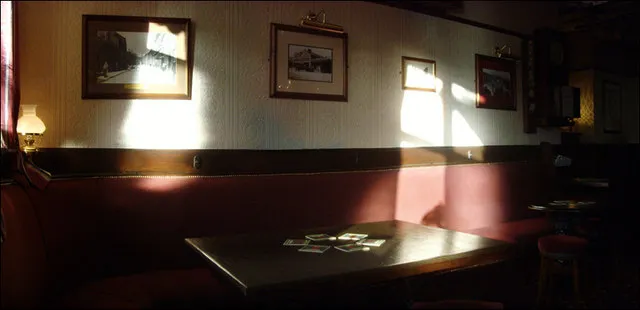
Photo: Howard Selina, CC BY-SA 2.0, via Wikimedia Commons
A pair of adaptive spectacles leaves the house each morning carrying a prescription, a set of tolerances and a small amount of battery. What it does not carry is control over the room it will be worn in. Contrast, glare, ambient noise and the angle of a light fitting are decided by whoever designed the space — which means that a good deal of what a wearer calls ‘seeing well’ is, in practice, a service standard waiting to be set.
UK hospitality has already learned this lesson once. Allergen information moved from a discretionary courtesy to an expected part of the offer, and menus changed accordingly. Sight deserves the same treatment. Under the Equality Act 2010, service providers carry a duty to make reasonable adjustments, and that duty is anticipatory: a venue should not wait for a guest to explain a difficulty before addressing the obvious ones.
What follows is a working checklist for pubs, cafés and restaurants — cheap to implement, unglamorous, and disproportionately useful.
The room is part of the optical system
Adaptive eyewear adjusts to conditions. It does not abolish them. Photochromic lenses take time to change; electronically tinted lenses take a moment longer; magnifying and contrast-enhancing systems amplify whatever contrast the room already offers, including the bad kind created by a glossy table reflecting a ceiling spotlight.
Venues tend to think about accessibility in terms of ramps, door widths and accessible toilets — all essential, all structural. Vision sits in a different category: it is ambient, continuous and entirely dependent on surfaces, light and layout. A step-free entrance to a dining room that is otherwise a hall of mirrors is only half an arrival.
Begin with the light, not the furniture
Lighting is the single most consequential change and usually the cheapest. Three practical rules cover most of it.
First, avoid placing unshielded downlights directly above tables. A bright source in the upper field of view causes discomfort and veiling glare, and no lens coating fully compensates for it. Second, keep overall light even. Pools of brightness surrounded by gloom force the eye to re-adapt constantly, which is tiring for everyone and especially so for wearers of adaptive or low-vision aids. Third, treat flickering candles, novelty filament bulbs and fast-cycling LEDs as decorative risks rather than atmosphere.
Where dimming is available, a mid-evening setting that keeps the room legible without flattening the mood is achievable in almost every venue. The test is simple: can a menu be read at the table without a phone torch?
Menus: contrast, matte, and the QR trap
A menu is the most-read document in any restaurant, and it is frequently the least legible.
- Print on matte or uncoated stock. Laminated menus are a mirror at the wrong angle.
- Use a genuinely high-contrast pairing — dark ink on a light ground, or the clear inverse. Mid-grey on cream is a design choice that quietly excludes.
- Set body text at 12 point or above, with generous leading, and avoid decorative scripts for dish descriptions.
- Never print text over a photograph or a patterned background.
- Keep a small stock of large-print copies. They cost little and are rarely refused.
- Treat QR codes as a supplement, not a replacement. A phone screen held at an angle in a dim room is a poor substitute for paper.
Tables, reflections and the line of sight
Seat placement matters more than most front-of-house teams realise. Guests should be able to sit with their back to a window or a bright wall rather than facing it, and staff can offer that choice without asking why. Glass-topped tables, mirrored bar backs, polished brass and open kitchen pass-throughs all create secondary light sources that adaptive lenses will faithfully transmit.
Where fixed seating prevents a good angle, a simple adjustment — turning a chair, lowering a blinds slat, or moving a table one place along — is usually enough. The rule for staff is to offer the option, not to interrogate the need.
Powered and voice-enabled eyewear in a busy room
An increasing number of adaptive devices are electronic. Voice output and voice control are common, and background noise is their principal enemy. Music levels that make conversation a strain also defeat directional microphones.
Two small provisions help. A charging point — a standard USB socket near a cloakroom or a quiet corner — reassures wearers on a long evening out. And a quieter table for anyone using spoken interfaces is a reasonable request that costs a venue nothing but attention.
Staff awareness without disclosure
No guest should have to narrate a diagnosis to be seated comfortably. Training should therefore be generic and practical:
- Never move or pick up a person's glasses. This includes moving them to wipe a table.
- Offer to read aloud, and accept a refusal gracefully.
- Describe the layout when guiding to a table — steps, tight corners, low beams.
- Ask before altering lighting or blinds, then do it promptly.
- Brief new starters on the same five points during induction.
The twelve-point venue checklist
- No unshielded downlights directly over dining tables.
- Even ambient light, with no severe pools of shadow.
- Matte, high-contrast printed menus as standard.
- At least two large-print menus kept behind the bar.
- QR codes offered alongside paper, never instead of it.
- Tables available where guests can sit with their back to the window.
- Gloss and mirror surfaces reviewed for reflected glare at seated eye level.
- Music kept below the level at which conversation falters.
- A public USB charging point available on request.
- Staff trained not to handle a guest's eyewear.
- Layout described verbally when guiding guests to a table.
- A named person responsible for reviewing the list each quarter.
What it costs, and what it returns
Most of this is a reprint budget and a bulb order. The returns are less tidy but real: longer dwell time, more confident returning custom, and the kind of reputation that shows up in listings on access information sites and in the recommendations disabled customers exchange with one another.
Clearer sight is not something a pair of glasses delivers on its own. It is delivered by a chain of small decisions — in the consulting room, at the kitchen table, and at the moment a guest is handed a menu in a room where somebody has already thought about the light.