Screening the Headset: An Accessibility Audit for Virtual Reality and Adaptive Eyewear in 2026
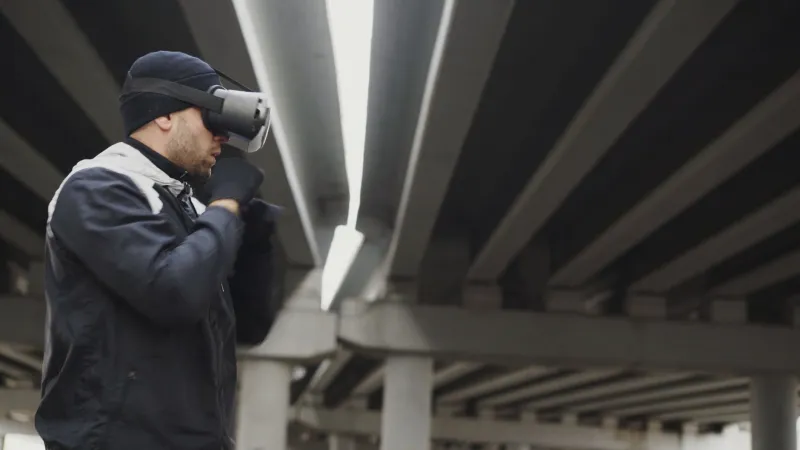
Virtual reality is no longer a novelty. In 2026 it is being deployed in NHS rehabilitation pilots, in workplace training for hazardous environments, and in classrooms as a tool for immersive learning. For many users, the headset is a useful addition to professional practice. For a significant number of adaptive eyewear wearers, it remains an obstacle course.
The promise and the blind spot
The case for virtual and mixed reality in public services is easy to see. Rehabilitation teams use it to create controlled environments for balance work, graded exposure and upper-limb training. Employers use it to rehearse risky tasks without putting anyone in danger. Schools use it to take pupils to places they could not otherwise visit. These are legitimate uses, and they will expand.
The blind spot is the face at the centre of the experience. Headsets are designed around a narrow model of how a head, a pair of eyes and a pair of spectacles fit together. Adaptive eyewear — varifocals, prism lenses, high prescriptions, therapeutic tints, specialist frames — often falls outside that model. The result is not merely discomfort. It can be exclusion dressed up as a technical limitation.
Why a headset and a pair of glasses so rarely get along
The problems are optical, mechanical and organisational. Optically, a headset holds lenses at a fixed distance from the eye. Spectacles sit at their own vertex distance, and varifocals depend on the wearer looking through the correct part of the lens. Tilting or pushing a headset can move the optical centre and blur the view. Prisms and high prescriptions may not translate neatly into add-on inserts.
Mechanically, frames have width, thickness and temples. Facial interfaces are shaped for particular face sizes and shapes. A headset that presses on the temples, lifts the frame or fogs the lenses is not a neutral inconvenience; it is a barrier. For some wearers, removing their glasses to use a headset is not an option. It may be unsafe, disorienting or simply impossible to participate without clear sight.
The insert question
Prescription lens inserts are the most common answer, and they can work well. But they are not a universal fix. Inserts need an accurate prescription, including pupillary distance, prism and reading addition where relevant. They add weight, reduce eye relief and may not support every prescription range. They also cost money, and it is rarely clear who should pay: the NHS, the employer, the school or the wearer.
There is a further issue of ownership and hygiene. Inserts are personal items. In a shared headset environment, they cannot simply be handed from one user to the next without a cleaning and calibration regime. If an organisation issues a headset but not an insert, it has not solved the accessibility problem; it has relocated it.
Spacers, interfaces and the fit gap
Spacers and alternative facial interfaces can help. A spacer increases the distance between the headset lenses and the wearer's face, creating room for spectacles. A different interface may relieve pressure points. But support is patchy. Not every model offers these options, and aftermarket solutions may affect warranty or performance.
Manufacturers should publish clear compatibility information: maximum frame width, temple thickness, lens vertex distance, supported prescription ranges and whether inserts are available. Buyers should not have to reverse-engineer this from forum posts. In the UK, public sector procurement and workplace risk assessments should ask for that information as a matter of course.
Hygiene and the shared headset
Shared headsets raise practical questions that go beyond optics. Facial interfaces and inserts need cleaning between users. Prescription inserts should not be shared. Wearers should not be asked to remove their glasses in order to use a device that then becomes unsafe or unusable. A cleaning protocol is not an optional extra; it is part of making the equipment fit for purpose.
Questions to ask before buying or being issued a headset
- Does the headset accept prescription lens inserts, and for which prescriptions?
- Is a spacer or alternative facial interface available for spectacle wearers?
- What are the maximum frame width and temple thickness?
- Can the wearer use their own adaptive eyewear, or is removal required?
- Who pays for inserts, and what is the lead time?
- How are shared headsets and inserts cleaned between users?
- Is there a trial period and a returns process if the fit is unsuitable?
- Has an individual accessibility assessment been carried out?
- For employers, has Access to Work or another adjustment route been considered?
- For schools, has the need been recorded in SEN support or an EHCP conversation?
- For NHS and public sector buyers, does the procurement include glasses compatibility?
The case for accessibility as a requirement
Headset makers should treat glasses compatibility as a core design requirement, not an optional accessory. Adjustable eye relief, standardised insert mounts and published specifications would make a material difference. UK employers and public services should treat compatibility as part of their duties under the Equality Act 2010 and as a sensible procurement condition. Reasonable adjustments are not a favour; they are how accessible services are built.
2026 is a test year for virtual reality in Britain. If the technology is to be adopted widely and fairly, it must accommodate the eyewear that people already rely on. A headset that only works for those with uncomplicated vision is not a universal tool. It is a narrower product with a wider marketing budget. The sector can do better, and buyers should insist that it does.