The Locked Frame Problem: Why Adaptive Eyewear Needs a Repair Standard That Works

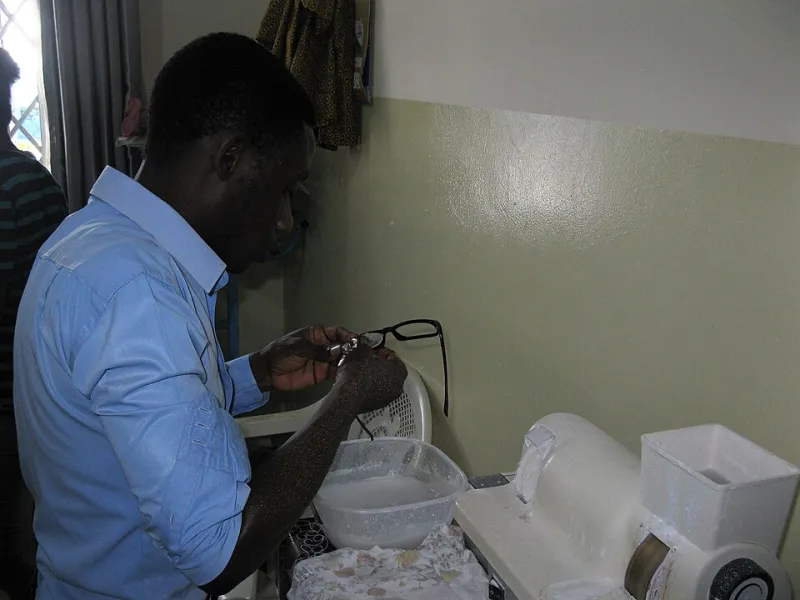
Photo: broken smart glasses with small screwdriver and battery on repair workbench, via thegoalchaser.com
Adaptive eyewear is not a gadget. It is a pair of glasses, a hearing aid for the eyes, a working tool and, for many people, a condition of taking part in daily life. That distinction matters when the device breaks. A cracked screen on a phone is an inconvenience; a failed battery in a pair of smart glasses can remove a person's ability to read, work, drive or recognise a face at a meeting. Yet the market still treats adaptive eyewear as a disposable consumer product, and the repair system around it has not caught up.
In 2026, the UK has a right-to-repair framework for certain appliances, a Consumer Rights Act that sets expectations for goods, and a growing public conversation about e-waste. What it does not have is a clear repair standard for eyewear that combines optical correction with electronics. That gap is the subject of this opinion piece, and it is not a niche concern.
A battery is not a lifestyle accessory
Consider the typical failure modes. A rechargeable battery loses capacity after two or three years. A sealed frame cannot be opened without specialist tools. A firmware update locks a device to a manufacturer's service network. A spare part is unavailable because the model has been discontinued. The result is predictable: the patient is offered a discount on a new pair rather than a repair, and the old pair becomes waste.
For a user who depends on that eyewear, the cost is not only financial. It is the cost of going without while a replacement is ordered, the cost of repeating an eye examination and fitting, and the cost of explaining to an employer or a school why the equipment they rely on has suddenly stopped working. A repair standard would not solve every problem, but it would make these failures less likely and less disruptive.
What UK law already says, and where it stops
The Consumer Rights Act 2015 gives consumers rights when goods are faulty, not as described, or not fit for purpose. The UK's right-to-repair provisions, which came into force in 2021 for certain products, require access to spare parts and repair information in specific categories. Neither framework was designed with adaptive eyewear in mind. Warranties often exclude batteries, accidental damage and normal wear, while the definition of 'normal wear' can be contested when a device is worn all day.
The result is a patchwork. A patient may have a strong legal case in theory but no practical route to a battery replacement in practice. A manufacturer may offer a repair service but only through a single postal address, with weeks of turnaround and no loaner device. A retailer may replace the frame but not transfer the prescription lenses. These are not abstract consumer complaints; they are accessibility failures.
The accessibility case for repair
Eyewear is assistive technology. The Equality Act 2010 does not create a specific right to a repaired pair of glasses, but it does recognise that access to goods and services matters for disabled people. When a device is essential for communication, mobility or work, a repair standard becomes part of the broader question of how society supports independence. A person should not have to choose between a repaired device and a replacement they cannot afford.
There is also a practical point about trust. Patients are more likely to adopt adaptive eyewear if they know it can be maintained. A device with a sealed battery and a two-year warranty may look sleek in a showroom, but it sends a clear message to the user: when it fails, you start again. That message is particularly damaging for older users, people on lower incomes and anyone who has already navigated a complex fitting process.
The sustainability case is not separate
Repair is often framed as an environmental issue, and it is. Every pair of smart glasses that is replaced rather than repaired represents embedded carbon, rare materials and electronic waste. But the sustainability argument is stronger when it is linked to accessibility. A repair-friendly device stays in use for longer, which reduces waste and keeps the user independent. The two goals reinforce each other.
A UK repair standard could therefore do more than divert waste from landfill. It could establish a baseline expectation that adaptive eyewear is built to be maintained, not merely sold. That would benefit manufacturers who invest in durable design, retailers who offer servicing, and patients who need continuity.
What a UK repair standard could look like
A workable standard does not need to be bureaucratic. It needs to be clear, enforceable and proportionate. Six measures would make a meaningful difference:
- Spare parts availability for a defined period, including batteries, hinge components and lens retention parts.
- Published repairability information at the point of sale, covering battery replacement, firmware access and service routes.
- A minimum warranty that distinguishes between consumable batteries and structural faults, with transparent terms.
- Firmware unlocking or service access after warranty, so independent repairers are not locked out by design.
- A loaner or emergency repair pathway for devices that are essential to daily living.
- Accessible service design, including postal repair, clear pricing and support for users who cannot easily travel.
These measures would not force every pair of glasses to be repairable in every circumstance. Safety, hygiene and optical calibration are real concerns. But they are arguments for controlled repair, not for sealed devices and proprietary batteries. A qualified technician can replace a battery without compromising lens alignment; a manufacturer can publish a service manual without exposing trade secrets.
The objection worth taking seriously
The strongest objection is that adaptive eyewear is a medical-adjacent product, and that repair could compromise safety. That concern deserves a serious answer. A repair standard should include competence requirements, traceable parts and post-repair testing. It should not allow a high-street phone shop to treat prescription eyewear like a toy. But the existence of risk is not a reason to make repair impossible. It is a reason to regulate it properly.
A right to see, not just a right to buy
The UK has spent recent years talking about repair in the context of washing machines and smartphones. Adaptive eyewear deserves the same attention. When a device is essential to sight, independence and participation, the question is not whether repair is convenient for the manufacturer. The question is whether the system respects the user.
A repair standard for adaptive eyewear in 2026 would be a modest reform with a large effect. It would tell patients that their eyewear is worth maintaining, tell manufacturers that durability is part of quality, and tell the wider accessibility sector that repair is not a side issue. The right to repair is, in this case, closely connected to the right to see. That connection should shape the next round of UK policy, warranty practice and product design.