Glare Is Not a Personal Problem: Britain's Transport Network and the Eyewear Wearer
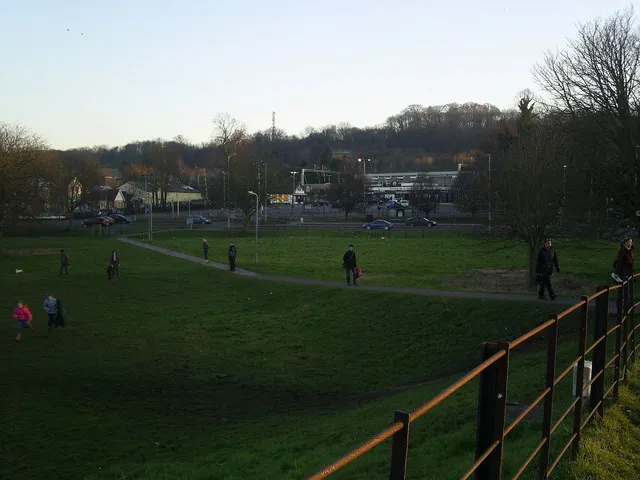
Photo: Graham Hale, CC BY-SA 2.0, via Wikimedia Commons
Consider the ordinary winter journey. A passenger leaves a dimly lit street, enters a station concourse lit to retail brightness, walks across a polished floor that throws the ceiling back upwards, descends to a platform where low sun is funnelled between buildings, boards a train, and then emerges forty minutes later into a different quality of daylight entirely. For most travellers this is mildly uncomfortable. For someone wearing photochromic lenses, or managing photophobia, or reliant on a tint that cannot change fast enough, it is a chain of small failures that no amount of personal preparation fully resolves.
It is worth saying plainly, and at the outset, that this is not a matter of passengers failing to plan. It is a matter of environments being designed, lit and maintained without much thought for people whose vision is sensitive to light.
The mechanics of the problem
Photochromic lenses darken in response to ultraviolet light. That is a reasonable technology, and it works well outdoors. It works considerably less well in transit, because the glass around passengers filters much of the ultraviolet spectrum. Laminated vehicle glazing and train windows reduce activation, so a wearer may board in bright conditions with lenses only partly darkened, then sit behind glass that leaves them under-tinted for the duration of the journey and over-tinted on arrival at an enclosed concourse.
The reaction is also slow. Activation and fading each take a period measured in tens of seconds to minutes, and cold weather extends it. A train emerging from a tunnel into a bright cutting, or a bus turning from a shaded street into open sky, produces exactly the rapid change that photochromic chemistry handles least gracefully.
Add to this the lighting itself. Many stations have been relit with high-output, cool-white LED fittings chosen for energy efficiency and perceived safety. Where those fittings are visible from a low angle, or reflected from glossy flooring and glazed balustrades, the result is a space that is simultaneously brighter and harder to see in. Departure boards, advertising screens and ticket machines contribute their own points of glare. None of these features is individually indefensible. Together they form a visual environment that a significant minority of passengers cannot comfortably use.
What wearers describe
The patterns that emerge in conversation with adaptive eyewear users are consistent. There is the commute timed around the sun rather than the timetable — leaving later in winter because a particular platform faces east. There is the habit of carrying a second pair of glasses, or fit-over sunglasses, in a bag at all times. There is the careful selection of a seat on the shaded side of the carriage, and the quiet frustration of finding it taken. There is the decision, for some, simply not to travel at certain hours.
Each of these is a reasonable adaptation. None of them is a substitute for the environment being better designed, and the cumulative effect is a restriction on movement that is rarely recognised as such.
Practical measures that do help
For the individual passenger, some strategies are worth adopting. A backup pair — prescription sunglasses, clip-ons, or fit-over shields worn over the existing frames — removes reliance on a lens that may not have darkened in time. A brimmed hat is unfashionable and effective. Seat selection can be planned: many journey-planning apps and platform indicators make it possible to anticipate which side the sun will fall on for a given direction and time. Where a route offers a choice between a long glazed concourse and a shorter, more enclosed interchange, the latter is often kinder, even if it is slower. And for those who drive to the station, tinted lenses should not be worn after dusk; the DVLA standard is not a formality.
Complaints, meanwhile, are worth making even when the response is unpromising. Rail passengers should raise the issue with the operator first and, if unsatisfied, with Transport Focus; in London, London TravelWatch handles comparable cases. Bus users can approach the operator and Bus Users UK. It helps enormously to describe the problem in accessibility terms — a specific location, a specific time, a specific effect on the ability to use the station — rather than as a general grumble about lighting.
What operators should be asked to do
Under the Equality Act 2010, transport providers carry duties not to discriminate and to make reasonable adjustments, and the public sector equality duty applies to the bodies that plan and fund the network. Station design guidance already addresses accessible routes, tactile paving and contrast. Lighting and glare deserve the same treatment.
A modest agenda would include auditing concourse lighting for glare as well as for lux levels; specifying matte or low-reflectance flooring in refurbishments; providing shading or canopies at exposed platforms; publishing the lighting specifications used at major stations; training staff to understand that a request to sit out of the sun, or to wait somewhere shaded, is an access need rather than a preference; and including glare explicitly in the accessibility panels and passenger forums that operators already convene.
None of this is technologically difficult. Most of it costs little at the point of refurbishment and nothing at the point of design. What it requires is the recognition that light is part of the built environment, and that a station which is bright but visually hostile has not been made accessible.
A reasonable expectation
Passengers with adaptive eyewear are not asking for special treatment. They are asking for environments in which the ordinary business of catching a train does not depend on the sun's position, the reflectivity of a floor, or the reaction speed of a chemical coating. Glare is a design decision. It should be treated as one.